
Week 240 · Cape of Good Hope · Hout Bay · Penguins · Duilker Island
Cape
Getting to Cape Point is a little confusing — first there is the end of the peninsula south of Cape Town with mountains running along the ocean; second is the place "where the oceans meet" at Cape of Good Hope; third it is where the penguins are; fourth it is the southernmost part of Africa. Unfortunately some of these are in different places.
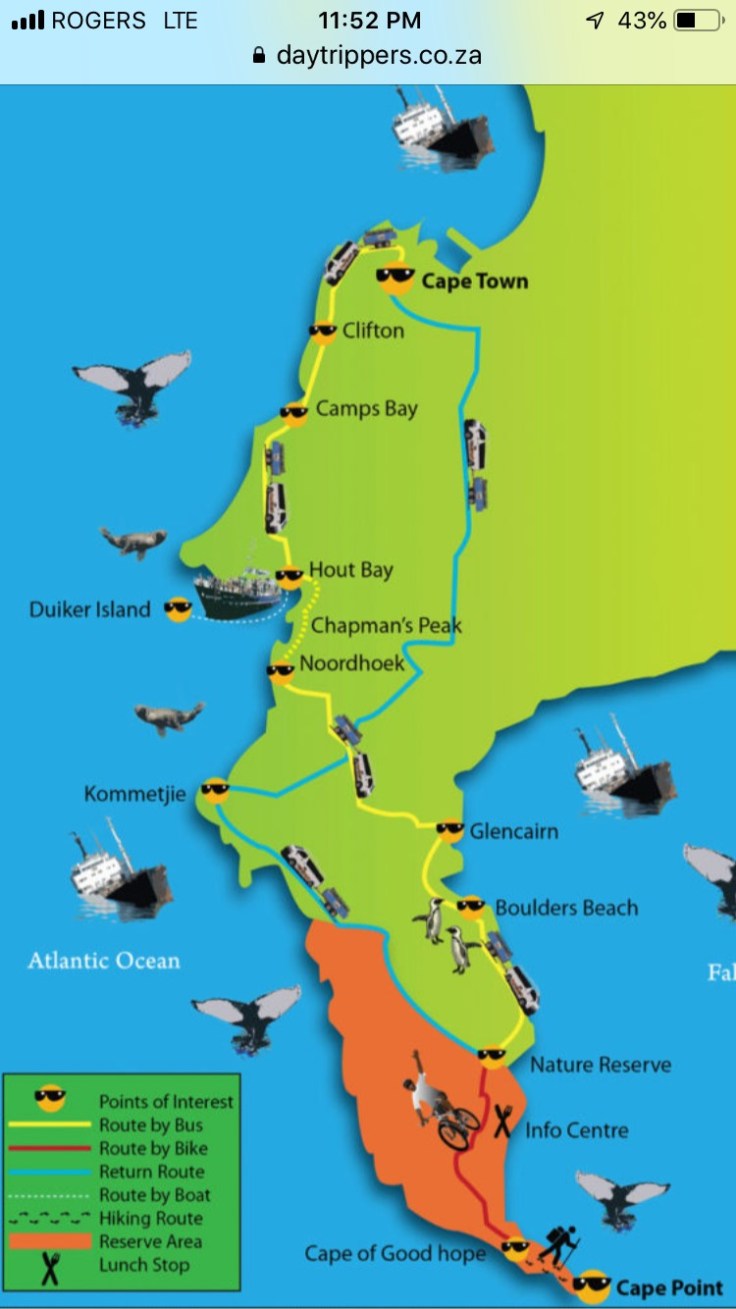
The map shows the approximate route we took to Cape of Good Hope — the most southwestern point of Africa, which is next to Cape Point (half a mile apart). Penguins are about an hour away and where the oceans officially meet at the southernmost part of Africa is two hours away. But our guide said the warm Indian Ocean currents come to Cape Point, so this was the unofficial meeting place.
We had a good group with about 15 people and included a boat ride, a short bike ride, a hike, and seeing the penguins. It was better than the mass tour which didn't have the hike — the hike was along the cliffs overlooking the Atlantic Ocean on one side and the Indian Ocean on the other.
Cape Point and the Cape of Good Hope are two separate headlands on the same peninsula, approximately 1.2 kilometres apart. Cape Point is the higher of the two at 249 metres. The Cape of Good Hope — the most southwesterly point of Africa — was first rounded by Portuguese explorer Bartolomeu Dias in 1488 and named by King John II of Portugal. The common belief that it is where the two oceans meet is geographically disputed — the true meeting of the Atlantic and Indian Oceans is generally considered to be at Cape Agulhas, 150 kilometres to the east, which is Africa's true southernmost point. The African Penguin colony at Boulders Beach near Simon's Town is one of the few mainland penguin colonies in Africa; from near extinction in the 20th century the colony has grown to approximately 2,000 birds, though the species remains endangered.


It was better than the mass tour which didn't have the hike. The hike was along the cliffs overlooking the Atlantic Ocean on one side and the Indian Ocean on the other — or so our guide told us. Our guide said the warm Indian Ocean currents come to Cape Point, so this was the unofficial meeting place of the two oceans.
Hout Bay was a good stop for a bike ride before heading to Cape Point. The peninsula drive itself is spectacular even before you get to the point.


"The hike was along the cliffs overlooking the Atlantic Ocean on one side and the Indian Ocean on the other — or so our guide said. Penguins about an hour away. Better than the mass tour."